GEOTECHNICAL ENGINEERING
SWANSEA
HomeSeismicSoil liquefaction analysis

Soil Liquefaction Analysis in Swansea: BS EN 1997-1 Compliance

Rigorous testing. Clear reporting.

LEARN MORE

Swansea's post-war expansion reshaped the lower Tawe valley with deep alluvial fills, pushing development onto silts and sands that the original town had avoided. Today, every brownfield scheme between the marina and the Liberty Stadium sits on ground where pore pressure can spike under cyclic load. Our laboratory runs liquefaction screening directly on samples extracted across the city, applying Eurocode 7 (BS EN 1997-1:2004) procedures and BS 5930 logging protocols. We combine index testing with triaxial cyclic stages to measure excess pore pressure build-up, and cross-check results against in-situ permeability values when site drainage is a design variable. The output feeds directly into foundation redesign cycles for Swansea schemes.

In Swansea's estuarine sands, a water table at 1.5 m depth means liquefaction screening is not optional — it’s the difference between a safe foundation and a post-event settlement claim.
Our service areas

Approach and scope

The geology beneath Swansea is dominated by glacial till overlying Coal Measures, but the critical liquefiable layers are the post-glacial estuarine sands mapped along the Tawe corridor. These sands have fines contents between 8% and 35% and a water table that sits barely 1.5–2.0 m below ground in the Maritime Quarter. For Swansea projects we run a three-tier analysis: first-pass screening using SPT N-values from SPT drilling logs, second-pass grain-size distribution to rule out non-plastic silts, and third-pass undrained cyclic triaxial testing on undisturbed Shelby-tube specimens. Each tier is documented to UK-specific amplification factors — Swansea sits in a moderate seismicity zone under the BGS seismic hazard model, with a 475-year return-period PGA around 0.04–0.06 g.
The laboratory operates under a UKAS-accredited ISO 17025 management system. Sample preparation follows BS 1377: Part 8 for dynamic testing, with back-pressure saturation and B-value checks above 0.95 before cyclic loading. Post-test grain-size curves are plotted to ASTM D422-equivalent sieving protocols to confirm the soil class boundary. All reports include the factor of safety against liquefaction (FSL) and the post-liquefaction volumetric strain estimate for settlement calculations.
Soil Liquefaction Analysis in Swansea: BS EN 1997-1 Compliance
Technical reference — Swansea

Site-specific factors

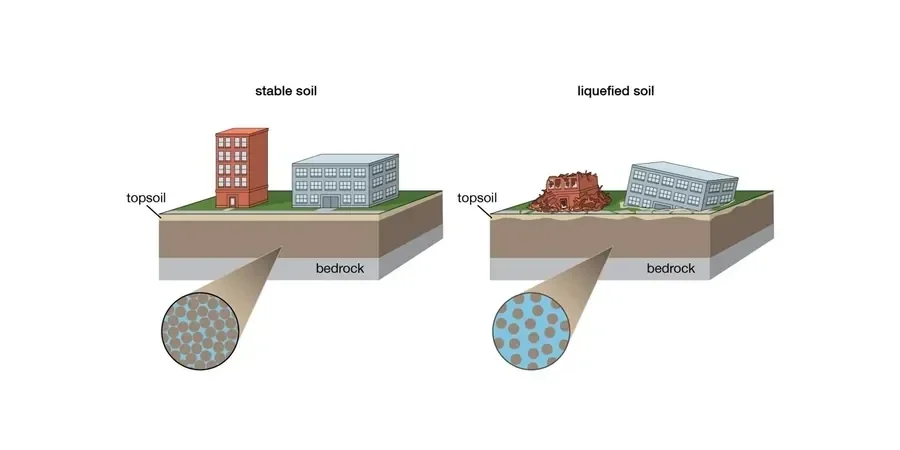
A Bishop-type triaxial cell sits on the bench pressurised at 400 kPa confining stress, cycling a Swansea silty sand specimen at 0.5 Hz. The pore-pressure transducer trace climbs with each cycle until the effective stress approaches zero — that moment defines the liquefaction trigger. Skipping this test and relying on SPT screening alone is risky in Swansea because the local estuarine fines are plastic enough to skew blow-count correlations. A false-negative screening result means a contractor pours a raft foundation on sand that flows during a moderate earthquake, and the post-event settlement can reach 80–150 mm. The physical evidence is visible in the lab: a specimen that was a solid cylinder before cycling turns into a slurry that cannot support its own weight. That is what happened in Christchurch, and the Tawe alluvium shares similar grain-size characteristics.

Need a geotechnical assessment?

Reply within 24h.

Email: contact@geotechnical-engineering.biz

Service video


Relevant standards

BS EN 1997-1:2004 (Eurocode 7, Geotechnical design), BS 5930:2015 (Site investigation code of practice), BS 1377-8:1990 (Triaxial compression, cyclic), NCEER/NSF 1997 (SPT-based liquefaction, Youd-Idriss), Boulanger-Idriss 2014 (CPT/SPT liquefaction triggering)

Technical parameters

ParameterTypical value
Analysis standardBS EN 1997-1:2004 + BS 5930:2015
Screening methodSPT-based (Youd-Idriss 2001) + grain-size curve
Cyclic test typeUndrained cyclic triaxial (BS 1377-8)
Specimen saturationBack-pressure, B-value ≥ 0.95
Loading frequency0.1–1.0 Hz (earthquake simulation)
Fines correctionFC-adjusted CRR curves (Boulanger-Idriss 2014)
Output parameterFSL + post-liquefaction settlement (cm)
Sample typeShelby tube or block sample (undisturbed)

Q&A

When is soil liquefaction analysis mandatory for a Swansea project?

Under Eurocode 7 (BS EN 1997-1:2004), a liquefaction assessment is required when the site has saturated loose to medium-dense sand within the top 20 m and the design seismic action exceeds the screening threshold. In Swansea, the BGS hazard model assigns a 475-year PGA of 0.04–0.06 g, which triggers the check for most sites along the Tawe floodplain. The analysis is mandatory for Importance Class 2 and above structures.

What laboratory tests do you run for liquefaction in Swansea?

We run undrained cyclic triaxial tests according to BS 1377-8 on undisturbed samples from Swansea sites. The sequence includes back-pressure saturation until B ≥ 0.95, isotropic consolidation to in-situ stress, and cyclic deviator loading at 0.1–1.0 Hz. We also perform grain-size distribution and Atterberg limits on each specimen to confirm the soil class. For preliminary screening, we correlate SPT N-values from local drilling logs using the Youd-Idriss (2001) framework with fines correction.

How much does a liquefaction analysis cost in Swansea?

A complete liquefaction analysis suite, including undisturbed sampling, cyclic triaxial testing on three specimens, grain-size analysis, and the final FSL report, typically ranges from £2,110 to £3,730 depending on the depth of sampling, number of specimens, and whether SPT screening is included. We provide a fixed-price quotation after reviewing the site investigation plan.

What is the difference between SPT screening and cyclic triaxial testing?

SPT screening uses blow-count correlations to estimate liquefaction resistance based on empirical databases. It is a first-pass method that works well in clean sands but can misclassify silty sands like those in Swansea's estuarine deposits. Cyclic triaxial testing applies actual earthquake-like loading to an undisturbed specimen in the lab and measures pore-pressure build-up directly, giving a site-specific factor of safety. We recommend both: screening for coverage, triaxial for confirmation on critical layers.

How long does a liquefaction study take for a Swansea site?

From sample collection on a Swansea site to the final report, allow 3–4 weeks. Undisturbed sampling and transport take 2–3 days. Laboratory testing—cyclic triaxial on three specimens plus index tests—requires 10–12 working days. The reporting phase, including FSL calculation and settlement estimation, takes an additional week. Expedited schedules are available for tight construction programmes.

Location and service area

We serve projects across Swansea and its metropolitan area.

View larger map