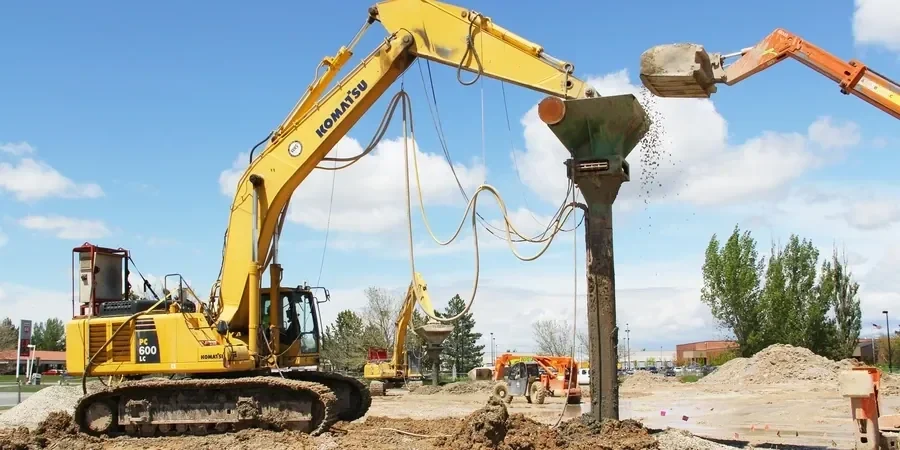
Ground improvement in Swansea encompasses a suite of geotechnical techniques designed to enhance the engineering properties of soils and fills, enabling safe and cost-effective construction. This category is critical because much of the region's natural ground comprises soft alluvial clays, estuarine silts, and areas of made ground that lack the bearing capacity or stiffness required for modern infrastructure. Without intervention, these weak soils can lead to excessive settlement, slope instability, and foundation failure. The improvement strategies applied here transform marginal land into viable building platforms, directly supporting the city's ongoing regeneration, from the Swansea Waterfront Innovation Quarter to residential expansions in the northern suburbs.
Swansea's geological setting is dominated by the legacy of its coastal and riverine environment. The low-lying areas along the River Tawe corridor and the former docklands are underlain by thick sequences of soft, normally consolidated clays and tidal flat deposits, often with high organic content and variable thicknesses. Inland, glacial till and weathered Coal Measures strata present their own challenges, including collapsible soils and shallow mine workings. These conditions demand a tailored approach to ground treatment, where methods like stone column design are frequently employed to reinforce compressible clay layers, improving both bearing capacity and drainage paths to accelerate consolidation.
The regulatory framework governing ground improvement in the UK is robust, with BS EN 1997-1:2004 (Eurocode 7: Geotechnical design) and its UK National Annex forming the backbone of design requirements. In Wales, these are complemented by the Welsh Building Regulations 2010 and guidance from bodies like the NHBC for residential developments. For projects involving vibro techniques, BS EN 14731:2005 on deep vibration applies, ensuring that vibrocompaction design meets stringent performance criteria for densifying loose granular fills. All improvement schemes must be validated through rigorous post-treatment testing, typically comprising cone penetration tests, load tests, and settlement monitoring to demonstrate compliance with the design brief.
A wide spectrum of projects in Swansea relies on ground improvement to overcome site constraints. Commercial developments on reclaimed docklands, such as the SA1 Swansea Waterfront, utilised deep vibro techniques to stabilise granular fills and stone columns to reinforce soft estuarine clays beneath roads and building footprints. Infrastructure schemes, including highway embankments and flood defence walls along the Tawe, demand treatment to prevent differential settlement and ensure long-term serviceability. Even smaller-scale residential plots on brownfield sites benefit from targeted improvement, transforming otherwise undevelopable plots into stable ground for housing. The selection between methods like stone column design and vibrocompaction design hinges on soil type, depth of treatment, and sensitivity of adjacent structures.
Ground improvement refers to techniques that modify the physical properties of soil to increase bearing capacity, reduce settlement, and mitigate liquefaction risk. In Swansea, it is essential due to widespread soft alluvial clays, estuarine silts, and historic made ground along the River Tawe and former docklands, which are naturally too weak to support conventional foundations without treatment.
The optimal method depends on the soil profile. For deep, soft cohesive soils, stone columns supply reinforcement and drainage. For loose granular fills and sands, vibrocompaction densifies the ground effectively. Dynamic compaction or rigid inclusions may also be considered for mixed fills, with the final choice guided by a detailed ground investigation and geotechnical assessment.
Design is governed by Eurocode 7 (BS EN 1997-1) and its UK National Annex, while execution follows standards like BS EN 14731 for deep vibration techniques. The ICE Specification for Ground Treatment also provides best practice, and all works must align with the Welsh Building Regulations and relevant NHBC standards for residential projects.
Programme duration varies with technique and site size, but many methods like vibrocompaction can treat several hundred square metres per day. Stone columns may require a short surcharge period for consolidation. When planned early, ground improvement adds predictability to the overall project timeline by eliminating the risk of unforeseen settlement during construction or post-completion.
We serve projects across Swansea and surrounding areas.