GEOTECHNICAL ENGINEERING
SWANSEA
HomeImprovementVibrocompaction design

Vibrocompaction Design in Swansea: Improvement for Challenging Soils

Rigorous testing. Clear reporting.

LEARN MORE

The ground beneath Swansea tells two very different stories. Down in the SA1 docks, you are almost certainly dealing with loose hydraulic fills and alluvial silts dumped during the Victorian copper-smelting boom, while up on the slopes of Townhill, the glacial till sits thin over the Coal Measures bedrock. This contrast means a standard foundation approach rarely works across the city. We design [vibrocompaction](/) programmes specifically tuned to these local profiles, densifying loose granular soils to prevent excessive settlement before construction starts. That pre-treatment step becomes critical when you combine Swansea's high water table with the legacy of backfilled docklands around the River Tawe. Without it, differential settlement can crack a slab within the first two years. Our lab verifies every stage against the BS 5930:2015 code of practice, so the design parameters match what is actually down there.

On Swansea's post-industrial fills, vibrocompaction design without pre-treatment grain-size verification is just guessing with a very loud machine.
Our service areas

Approach and scope

A mixed-use development we supported near the Liberty Stadium required vibro treatment across a site where the upper 4 metres consisted of loose, saturated ash and colliery spoil. The project demanded a minimum relative density of 70%, which we confirmed through before-and-after CPT testing at every grid point. Vibrocompaction design here is not just about picking a probe spacing from a textbook. We run grain-size distribution and minimum/maximum density tests on Shelby tube samples extracted before the rig moves in, then correlate those numbers with the specific vibrator horsepower available on Swansea jobs. The energy requirement in kilowatt-hours per cubic metre changes sharply if the fines content creeps above 12%, a common issue in the estuarine deposits near Crymlyn Burrows. By running a design-stage liquefaction assessment under the Mw 6.0 seismic scenario for South Wales, we also verify that the improved ground will not lose strength during a rare earthquake event, a check often skipped on smaller projects.
Vibrocompaction Design in Swansea: Improvement for Challenging Soils
Technical reference — Swansea

Site-specific factors

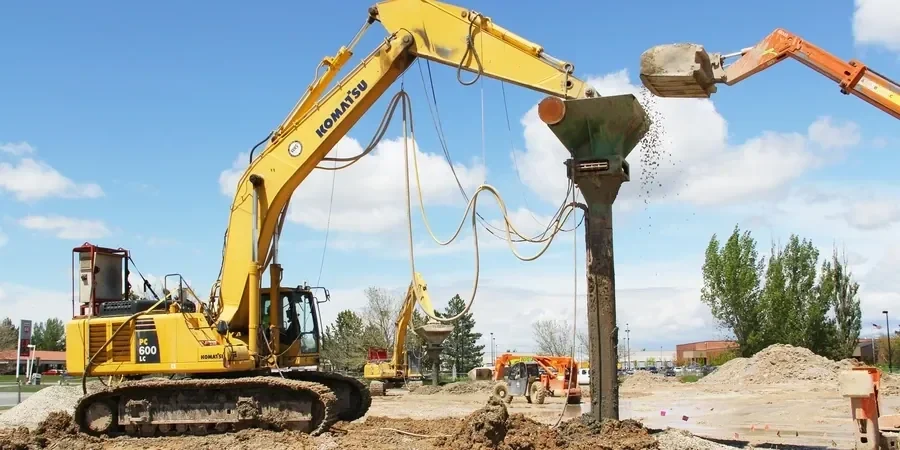
A vibroflot is a brutally simple piece of equipment: a 2.3-metre-long steel cylinder with an eccentric weight spinning inside it, suspended from a crawler crane that you will see on Swansea dockside jobs, often working against a backdrop of grey drizzle. Its job is to fluidise the ground momentarily, allowing sand grains to repack into a denser state. The risk lies in what happens when the probe hits an obstruction buried in the fill. Swansea's industrial past means we regularly encounter old timber piles, slag boulders, and forgotten brick culverts that will deflect the vibrator off-vertical. If the operator does not catch the ammeter spike and the sudden drop in penetration rate, the compaction column becomes skewed, leaving an untreated window in the grid. Our design reports include a desk-study review of historical Ordnance Survey maps from 1880 onwards precisely to flag these buried features before mobilisation.

Need a geotechnical assessment?

Reply within 24h.

Email: contact@geotechnical-engineering.biz

Relevant standards


BS 5930:2015+A1:2020 – Code of practice for ground investigations, BS EN 1997-1:2004 (Eurocode 7) – Geotechnical design, general rules, BS 1377-2:2022 – Methods of test for soils: classification and compaction-related tests, ASTM D4253/D4254 – Maximum and minimum index density of soils (referenced for relative density correlation)

Technical parameters

ParameterTypical value
Minimum relative density target (Dr)65-85% depending on foundation sensitivity
Maximum effective depth15 m with electric vibroflot, 20 m with hydraulic rig
Maximum allowable fines content<15% passing 75µm sieve (BS 1377-2)
Typical probe spacing (square grid)1.8 to 3.2 m centre-to-centre
Energy input range2.5 to 4.5 kWh/m³ of treated soil
Design standard for verificationBS EN 1997-2 (Eurocode 7, Part 2)
Pre-treatment sampling depthEvery 1.0 m in critical layers, minimum 3 boreholes per zone

Q&A

What is the typical cost range for vibrocompaction design and testing in Swansea?

For a complete design package including laboratory classification, vibrocompaction specification, and post-treatment verification on a single residential or light commercial plot, the cost in Swansea typically runs between £1,270 and £3,660, depending on the treatment depth, number of verification points, and whether a desk-study of historical mine workings is required.

How deep can vibrocompaction effectively treat the loose sands found in Swansea's docklands?

With the electric vibroflots commonly available in South Wales, effective treatment reaches about 15 metres below working platform level. On deeper alluvial sequences, such as those encountered near the Prince of Wales Dock, we specify a bottom-feed hydraulic rig that can extend treatment to 20 metres, provided the fines content remains below the 15% threshold that would switch the design to stone columns instead.

How do you confirm the ground has actually been compacted to the design specification?

Verification follows a strict before-and-after protocol. We establish baseline CPT tip resistance and sleeve friction profiles at every grid node before compaction, then repeat the soundings at offset locations after treatment. The design specification requires a minimum increase in cone resistance, typically a factor of 1.8 to 2.5 over the pre-treatment value, plus a direct measurement of relative density from sand-cone tests in the upper 2 metres where stress levels are low.

Location and service area

We serve projects across Swansea and its metropolitan area. More info.

View larger map