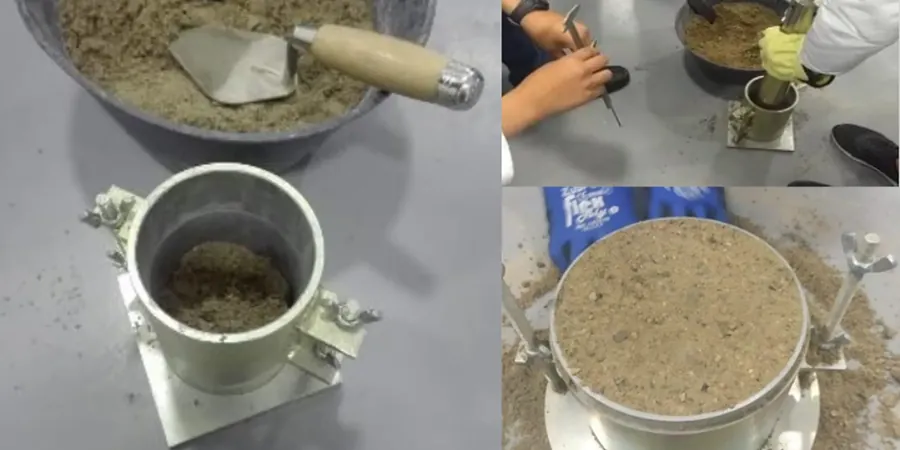
In-situ testing forms the backbone of geotechnical investigations across Swansea, providing engineers with direct measurements of ground conditions without the disturbance associated with sampling and laboratory work. This category encompasses a comprehensive range of field tests designed to evaluate soil strength, density, permeability, and deformation characteristics in their natural state. From the coastal alluvial plains of Swansea Bay to the glacial tills mantling the hinterland, the ability to assess ground behaviour on site is critical for managing the city's complex and often challenging subsurface profile. In-situ methods reduce uncertainty in foundation design, slope stability analysis, and earthworks specification, directly informing safer and more economical construction.
Swansea's geological setting amplifies the importance of rigorous in-situ investigation. The city straddles a transition from the Coal Measures of the South Wales Coalfield to the north, through glacial and periglacial deposits, to the marine and estuarine alluvium of the Tawe and Neath river corridors. Glacial till, often overconsolidated and containing cobbles and boulders, presents significant variability that cannot be reliably characterised from borehole logs alone. Equally, the soft, compressible estuarine clays and silts found in the SA1 docklands and coastal regeneration zones demand precise determination of undrained shear strength and consolidation parameters. In-situ techniques like cone penetration testing and field vane testing are indispensable for profiling these deposits accurately.
All in-situ work in Swansea must conform to the relevant British Standards, primarily the BS 5930:2015+A1:2020 Code of Practice for Ground Investigations, which is the overarching UK framework. Specific test methods are governed by their own standards, such as BS 1377-9 for in-situ tests in soils. Crucially, for projects involving earthworks, the Specification for Highway Works (SHW) Series 600, as adopted by the Welsh Government, dictates strict end-product and method specifications. A key requirement within this framework is the field density test (sand cone method), used extensively for verifying the compaction of structural fill and trench reinstatements in public highways. Compliance with Eurocode 7 (BS EN 1997-2) is also mandatory, requiring a structured approach to ground investigation where in-situ testing is a core component of deriving characteristic ground parameters.
This category of testing is fundamental to a diverse spectrum of projects shaping modern Swansea. Large-scale regeneration schemes, such as the ongoing transformation of the Hafod-Morfa Copperworks site and new residential developments on brownfield land, rely on in-situ permeability tests and gas monitoring to manage contamination and ground gas risks. Coastal defence works along the Swansea Bay frontage need reliable shear strength data from field vanes and dynamic probing to ensure stability under tidal and storm loading. Infrastructure projects, including wind farm cable routes and highway improvements on the A483, demand robust compaction verification through plate load testing and the sand cone density method. Even smaller domestic extensions on sloping sites in areas like Townhill or Sketty benefit from in-situ assessment of the near-surface drift deposits to mitigate landslip potential.
In-situ testing measures soil and rock properties directly in their natural state, avoiding the disturbance caused by sampling, transport, and preparation for the lab. This preserves the in-situ stresses, fabric, and moisture content, providing data that is often more representative of true ground behaviour, particularly for sensitive clays, granular soils, and fractured rock masses common in the Swansea region.
The overarching standard is BS 5930:2015+A1:2020, the Code of Practice for Ground Investigations. Specific test methods follow standards like BS 1377-9 for soils. All work must be framed by Eurocode 7 (BS EN 1997-2) for geotechnical design. For highway and earthworks projects, the Specification for Highway Works (SHW) Series 600, as mandated by the Welsh Government, sets strict requirements for compaction testing and end-product verification.
Swansea's geology ranges from soft, compressible estuarine alluvium in coastal zones to stiff, boulder-strewn glacial tills and Coal Measures bedrock. This variability demands a flexible approach: cone penetration testing (CPT) is ideal for profiling soft soils, while dynamic probing or Standard Penetration Testing (SPT) is needed for dense granular and glacial deposits. The groundwater regime and potential for gas in alluvial soils also necessitate specific in-situ monitoring.
In-situ testing is essential throughout a project's lifecycle. During the pre-construction ground investigation phase, it characterises ground profiles and design parameters. During earthworks construction, methods like the sand cone density test are used for continuous compaction verification. Post-construction, in-situ permeability or integrity testing may be required to validate the performance of engineered fills, landfill liners, or remediation systems.
We serve projects across Swansea and surrounding areas.