GEOTECHNICAL ENGINEERING
SWANSEA
HomeSlopes & WallsActive/passive anchor design

Active and Passive Anchor Design in Swansea: Ground Support That Holds

Rigorous testing. Clear reporting.

LEARN MORE

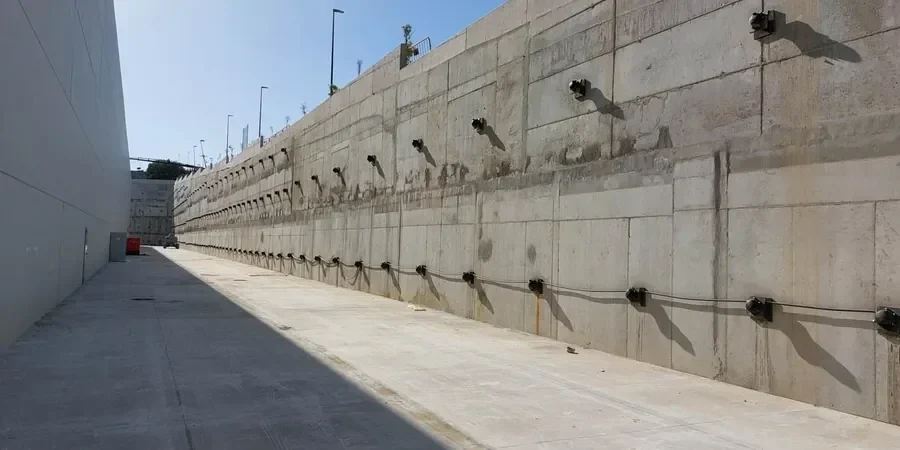
A waterfront development in Swansea Marina recently hit a snag when the excavation for a two-level basement encountered decomposed sandstone at just 3 metres. The contractor had planned a standard cantilever retaining wall, but the ground was too soft to resist the lateral earth pressures without significant movement. This is the reality of building in Swansea, where glacial till, alluvial clays, and weathered Coal Measures rock can change drastically within a single site. For situations like this, an active anchor system provides the necessary restraint without excessive concrete and steel, locking the wall back into competent ground. It’s a solution we’ve specified for projects from the SA1 redevelopment to hillside plots in Sketty, often integrating a slope stability analysis when the site steps back into a natural gradient. The goal is always the same: a design that understands the ground before asking it to perform.

A well-designed anchor doesn’t just resist load—it mobilises the soil or rock mass itself as part of the structural system, turning a potential failure plane into a stable composite block.
Our service areas

Approach and scope

Swansea’s post-industrial landscape, with a population of roughly 240,000 spread across the coastal plain and the Lower Swansea Valley, presents a layered geotechnical puzzle. You’ll find made ground over soft alluvium near the River Tawe, while the northern suburbs sit on stiffer glacial deposits. Our anchor design process starts with a forensic look at the ground investigation data—often supplementing it with test pits to physically inspect the strata where the anchor bond zone will be established. We size the tendon, calculate the unbonded length, and determine the grout-to-ground bond stress based on BS 8081:2015 guidance, confirming that each anchor can carry its working load with a minimum factor of safety of 2.0 against ultimate pull-out. The designs consider both temporary works cases, like a 12-month basement construction sequence, and permanent anchors with double corrosion protection for a 60-year service life in Swansea’s often aggressive, sulphate-rich ground conditions.
Active and Passive Anchor Design in Swansea: Ground Support That Holds
Technical reference — Swansea

Site-specific factors

The most common mistake we see on Swansea sites is underestimating the influence of groundwater on anchor capacity, especially in the alluvial gravels near the Tawe. A contractor will sometimes install a passive anchor system without effective dewatering, only to find the grout has washed out before it sets, leaving a tendon with zero bond and a retaining wall that begins to deflect. We’ve also investigated failures where anchors were proof-tested to the wrong acceptance criteria, masking a creep problem that later led to total load loss. Our team insists on a site-specific testing regime for every anchor type, including sacrificial anchors tested to failure on the first site visit. This approach, combined with strict adherence to BS EN ISO 22477-5 for testing, ensures that the design assumptions are validated in the actual ground conditions, not just on paper.

Need a geotechnical assessment?

Reply within 24h.

Email: contact@geotechnical-engineering.biz

Relevant standards


BS 8081:2015 – Code of practice for grouted anchors, BS EN 1997-1:2004 (Eurocode 7) – Geotechnical design, BS EN ISO 22477-5:2018 – Testing of geotechnical structures, BS 5930:2015+A1:2020 – Code of practice for ground investigations

Technical parameters

ParameterTypical value
Design code for ground anchorsBS 8081:2015, BS EN 1997-1 (Eurocode 7)
Typical bond stress in Swansea Mercia Mudstone400 - 600 kPa (preliminary)
Anchor type classificationActive (prestressed) and Passive (reactive)
Minimum factor of safety on tendon yield1.67 (temporary), 1.87 (permanent)
Corrosion protection for permanent anchorsDouble corrosion protection (DCP) per BS 8081
Typical investigation borehole depth below anchor5 m minimum into competent bearing stratum
Proof load testing acceptance criteriaCreep rate < 1 mm per log cycle at 1.5x working load

Q&A

What’s the difference between an active and a passive anchor?

An active anchor is prestressed after installation—it’s tensioned against the structure, actively compressing the ground and limiting movement from the start. A passive anchor is not prestressed; it only develops its resisting force once the structure begins to move and stretches the tendon. For a retaining wall in Swansea’s soft clays where even small movements could damage adjacent buildings, we typically specify active anchors to control deflections from day one.

How much does an anchor design and installation typically cost in Swansea?

For a full design package, including ground investigation review, anchor calculations, and on-site proof testing specification, the fee generally falls between £720 and £2,720, depending on the number of anchors and the complexity of the ground conditions. The installation cost itself is separate and depends heavily on access, depth, and the drilling method required.

What ground conditions in Swansea are problematic for anchors?

The biggest challenge locally is the buried soft alluvium and peat layers in the river corridor, which offer very low bond stress and are prone to creep. Made ground from the city’s industrial past can also contain obstructions and voids that complicate drilling and grouting. We address this by extending the anchor bond zone well into the underlying competent Mercia Mudstone or Pennant Sandstone, and specifying full-length casing in the weak overburden to prevent hole collapse during installation.

Location and service area

We serve projects across Swansea and its metropolitan area.

View larger map