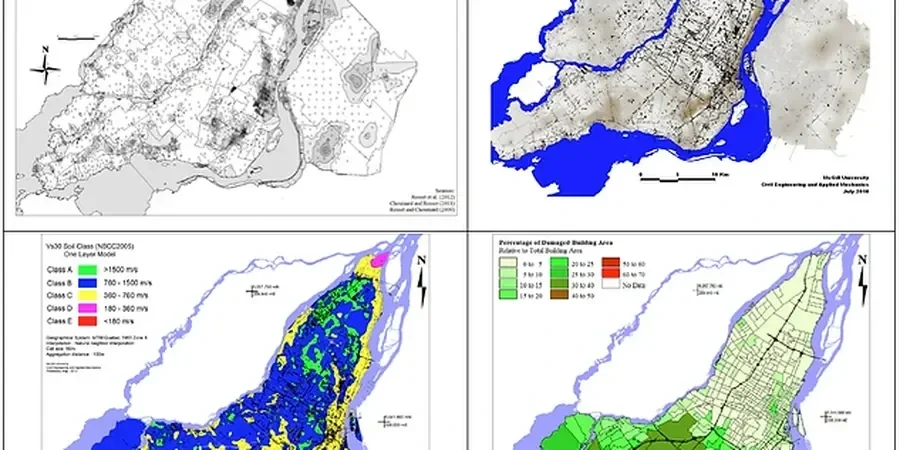
Seismic engineering in Swansea addresses the design and assessment of structures to withstand earthquake forces, a consideration that has gained prominence as awareness of the UK's seismic hazard evolves. While the United Kingdom is not typically associated with destructive earthquakes, the region experiences regular low-to-moderate seismicity, with Swansea lying within a zone influenced by ancient fault systems and intraplate stress. This category encompasses a suite of specialised solutions—including soil liquefaction analysis, base isolation seismic design, and seismic microzonation—that collectively ensure new developments and existing assets are resilient against ground shaking. For a coastal city like Swansea, where regeneration projects and critical infrastructure are expanding, integrating seismic considerations early in the planning process is not merely prudent but increasingly a requirement under modern codes.
Swansea's geological setting directly influences its seismic response. The city is underlain by a complex sequence of Carboniferous Coal Measures, comprising interbedded sandstones, siltstones, and mudstones, overlain in lower-lying areas by glacial till and alluvial deposits. These superficial materials, particularly the soft estuarine clays and saturated sands found along the Tawe corridor and Swansea Bay waterfront, can amplify ground motions and are susceptible to phenomena such as liquefaction. The South Wales Coalfield's structural geology, with its network of faults including the Swansea Valley Disturbance, contributes to the local seismotectonic framework. Understanding these conditions is essential for accurate hazard assessment, and seismic microzonation studies supply the granular mapping needed to differentiate risk across the urban area, guiding land-use planning and foundation design.
The applicable regulatory framework in the UK is anchored in Eurocode 8 (BS EN 1998): Design of structures for earthquake resistance, which sets out performance requirements, ground motion parameters, and design methodologies. For Swansea, the UK National Annex to BS EN 1998-1 defines the reference peak ground acceleration on rock for a 475-year return period, typically placing the region in a low-seismicity category but still mandating checks for certain structure types. Complementary standards such as BS 5930 for site investigation and BS EN 1997-1 for geotechnical design govern ground characterisation. Projects involving special-risk facilities, tall buildings, or infrastructure may trigger a detailed seismic hazard assessment, where advanced techniques like base isolation seismic design can be employed to decouple structures from ground motion, significantly enhancing performance beyond conventional ductile design approaches.
A diverse range of projects in Swansea requires seismic input, from the ongoing Swansea Central regeneration and high-density residential towers to marine terminals, bridges, and energy infrastructure along the docks. Educational campuses, hospital expansions, and data centres—where operational continuity is critical—also fall under this umbrella. For sites with saturated granular soils, soil liquefaction analysis becomes a cornerstone of the geotechnical investigation, evaluating the risk of strength loss and settlement during shaking. Industrial facilities handling hazardous materials must satisfy COMAH (Control of Major Accident Hazards) regulations, often necessitating a full seismic safety case. Even retrofit and refurbishment of Swansea's historic civic buildings and viaducts benefit from seismic screening to prioritise structural interventions, ensuring heritage assets are protected against long-term risks.
Yes. Although the UK experiences relatively low seismicity, Swansea lies in an area with a recognised seismic hazard under Eurocode 8. The UK National Annex requires seismic checks for important structures, tall buildings, and critical infrastructure. Neglecting these can lead to non-compliance with building regulations and potential vulnerability during rare but possible events, particularly on soft soil sites where ground motion amplification occurs.
Seismic microzonation divides an area into zones based on local ground response, considering soil type, geology, and fault proximity. For Swansea's varied terrain—from rock outcrops to deep alluvial deposits—it provides a detailed hazard map that informs planning, foundation design, and structural loading. This targeted approach avoids blanket conservatism, optimising construction costs while ensuring safety across different parts of the city.
The primary standard is BS EN 1998 (Eurocode 8) with its UK National Annex, which specifies seismic actions, ground types, and design procedures. It works alongside BS EN 1997 for geotechnical aspects and BS 5930 for site investigation. For hazardous industrial sites, COMAH regulations may also apply. Compliance with these codes is typically enforced through the building control process and structural warranty requirements.
Yes, liquefaction is possible in areas with loose, saturated sandy soils, such as estuarine deposits along the River Tawe and Swansea Bay waterfront. Assessment involves in-situ testing (CPT, SPT) to evaluate soil density and groundwater conditions, followed by cyclic stress analysis under design earthquake loading. If the risk is significant, ground improvement or deep foundation solutions are recommended to mitigate settlement and loss of bearing capacity.
We serve projects across Swansea and surrounding areas.