GEOTECHNICAL ENGINEERING
SWANSEA
HomeInvestigationSPT (Standard Penetration Test)

SPT (Standard Penetration Test) in Swansea: Site Investigation to BS 5930

Rigorous testing. Clear reporting.

LEARN MORE

When a new development breaks ground anywhere from the Swansea Enterprise Park to the coastal fringes of Mumbles, the first technical question is always the same: what is the ground made of, and how will it behave under load? The Standard Penetration Test remains the backbone of site investigation in the UK because it delivers a straightforward, repeatable N-value that feeds directly into bearing capacity equations and settlement analysis. In Swansea, that N-value takes on extra significance. The city straddles a geological boundary between Carboniferous sandstone and mudstone to the north, and deep sequences of glacial till, alluvial sands, and estuarine silts along the Tawe corridor. Eurocode 7 (BS EN 1997-2:2007) demands that ground investigation be sufficient to establish a geotechnical model, and BS 5930:2015 sets out the procedure we follow on every borehole. We run SPTs at 1.5 m intervals or at every stratum change, logging the blow counts, recovering disturbed samples, and noting any signs of groundwater. For a contractor or consulting engineer in Swansea, that data is what separates a confident foundation design from a costly over-excavation later. We often combine the SPT programme with CPT soundings where the soil profile is fine-grained or where pore pressure data is needed to refine the liquefaction assessment, particularly in the lower-lying Docklands area.

An SPT N-value is not just a number on a log—it is the first tangible piece of evidence that connects the ground model to the structural design.

Our service areas

Approach and scope

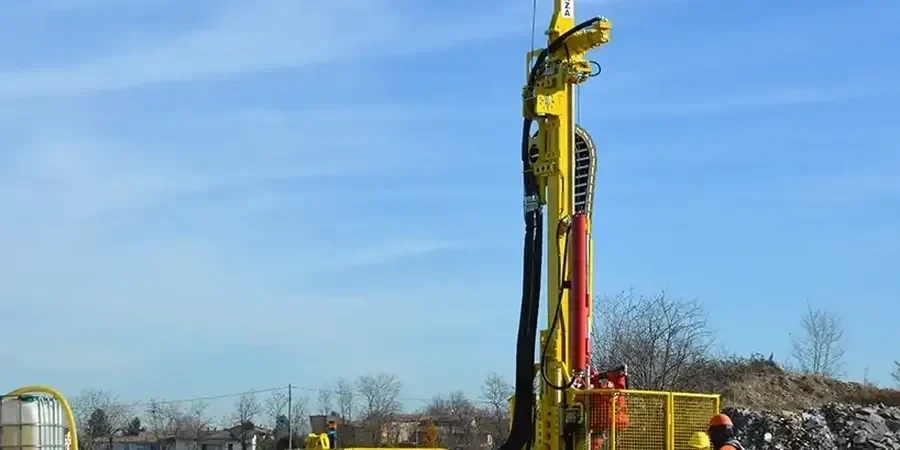
Swansea's post-war expansion and the more recent SA1 redevelopment have reshaped large areas of the city, but the ground beneath has a longer memory. The lower Swansea Valley was once a maze of docks, canals, and copper works, and decades of industrial activity left behind a patchwork of made ground, buried foundations, and occasional slag fill. When we mobilise a rig in areas like Hafod or Landore, the SPT hammer often tells the story before the lab does: erratic blow counts, sudden refusal on old masonry, or layers of black, odorous fill that require careful logging. BS 5930:2015+A1:2020 is particularly useful here because it gives clear guidance on dealing with anthropogenic deposits—classifying them, recording their composition, and deciding when they should be stripped or bypassed. The test itself is deceptively simple: a 63.5 kg hammer falling 760 mm drives a split-spoon sampler 450 mm into the soil, and we count the blows for each 75 mm increment. The N-value is the sum of the second and third increments, but experienced operators know that the real insight often comes from the first increment—the seating drive—which can reveal a crust or a disturbed zone before the sampler reaches undisturbed material. In Swansea's glacial tills, N-values typically range from 15 to 35 in the stiffer lodgement till, dropping to single digits where the till is weathered or where lenses of laminated clay appear. Those numbers translate directly into allowable bearing pressures and pile skin friction values that structural engineers need on day one of design.
SPT (Standard Penetration Test) in Swansea: Site Investigation to BS 5930
Technical reference — Swansea

Site-specific factors

Compare two sites on opposite sides of the city, and the risk profile changes completely. A project in Killay or Sketty, sitting on well-drained glacial sands and gravels over Devensian till, is a different world from a brownfield plot near the River Tawe in St Thomas or Port Tennant. In the western suburbs, SPT refusal often occurs within 3 to 5 metres on dense gravel, and the main concern is whether the granular layers are clean enough to avoid clogging during CFA piling. Over on the east bank of the Tawe, where the ground is dominated by soft alluvial silts and organic clays up to 8 metres thick, blow counts under 5 are not unusual, and the risk of excessive settlement under load is real. The SPT becomes a screening tool for problem ground: N-values below 4 in the upper 6 metres trigger a closer look at consolidation potential, and we will often recommend complementary Atterberg limit tests and oedometer consolidation tests to quantify just how much settlement to expect. The city's post-industrial legacy adds another layer: buried timber piles from old quay walls, slag from the copper smelters, and undocumented fill that can fool a casual reading of the SPT log. That is why our field technicians in Swansea are trained to record every detail—drilling resistance, water strikes, sample recovery, and the colour and odour of the cuttings—because in this city, what you miss in the field can cost six figures in the ground.

Need a geotechnical assessment?

Reply within 24h.

Email: contact@geotechnical-engineering.biz

Relevant standards


BS 5930:2015+A1:2020 — Code of practice for ground investigations, BS EN ISO 22475-1:2021 — Geotechnical investigation and testing. Sampling methods, Eurocode 7: BS EN 1997-2:2007 — Ground investigation and testing

Technical parameters

ParameterTypical value
Hammer typeAutomatic trip hammer (63.5 kg, 760 mm drop)
SamplerStandard split-spoon (BS 5930)
Test interval1.5 m depth intervals or at stratum change
Borehole diameter100 mm to 150 mm (rotary open-hole or cable percussion)
N-value correctionEnergy ratio (ER) corrected to 60% per Seed & Idriss
Reporting standardBS 5930:2015+A1:2020, BS EN ISO 22475-1:2021

Q&A

How much does an SPT investigation cost for a typical Swansea residential plot?

For a standard single borehole to 10 metres depth with SPTs at regular intervals, plus a factual report, the cost typically falls in the range of £490 to £580. The final figure depends on access conditions, the drilling method required, and whether laboratory testing is included. Sites in Swansea with difficult access—narrow lanes in Uplands, for example, or back gardens with limited rig clearance—may need a smaller track-mounted rig, which can affect the day rate slightly.

What is the difference between an SPT and a CPT, and when should I choose one over the other for a Swansea site?

The SPT provides a disturbed soil sample and a blow count (N-value) that correlates well with relative density in sands and consistency in clays. The CPT gives a continuous profile of tip resistance and sleeve friction but no sample. In Swansea, we often recommend SPT where the ground contains gravel, cobbles, or made ground that would damage a CPT cone. CPT works well in the soft alluvial silts along the Tawe corridor, where the continuous profile helps map thin layers that an SPT at 1.5 m intervals might miss. Many projects benefit from using both: SPT for sampling and soil identification, CPT for detailed stratigraphy.

How deep do you typically need to drill an SPT borehole for a two-storey extension in Swansea?

For a two-storey residential extension on strip or pad footings, the investigation depth is usually governed by the zone of influence of the foundation. BS 5930 recommends exploring to a depth where the stress increase from the foundation is less than 10% of the existing overburden pressure. In practice, for a lightly loaded two-storey structure in Swansea, this typically means drilling to 6 to 8 metres depth, with SPTs at the standard 1.5 m intervals. If the borehole encounters soft alluvial deposits—common in parts of St Thomas or near the marina—we will often extend the depth to confirm that a competent bearing stratum exists within a reasonable depth.

Location and service area

We serve projects across Swansea and its metropolitan area.

View larger map