GEOTECHNICAL ENGINEERING
SWANSEA
HomeGeophysicsMASW / VS30 (shear wave velocity)

MASW Testing & VS30 Shear Wave Velocity Surveys in Swansea

Rigorous testing. Clear reporting.

LEARN MORE

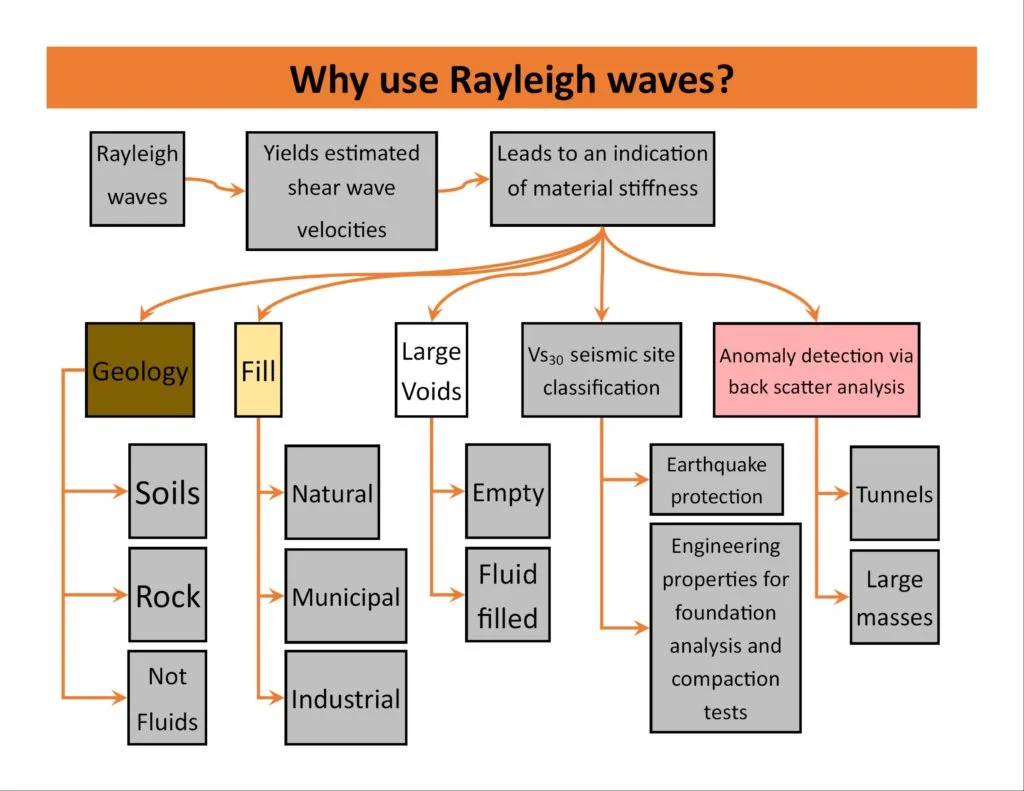
Swansea's urban fabric stretches from the Tawe river corridor across perched valleys carved into Pennant sandstone, but the near-surface geology tells a more complicated story. Glacial till and soft estuarine silts blanket much of the city centre and SA1, creating abrupt stiffness transitions that catch out generic ground models. A standard borehole log won't capture the shear wave velocity profile — and that's where the MASW method earns its place. We run 24-channel linear arrays across the site, recording Rayleigh wave dispersion to invert a 1D VS profile down to 30 metres. The output is the VS30 value that Eurocode 8 demands for seismic site class. In our experience across South Wales, this parameter flips a design from ground type D to C more often than desk-study assumptions would suggest, directly reducing seismic load factors for footings and structural frames.

A 50 m/s difference in VS30 can change your seismic site class — and your Improvement budget — before the first pile is designed.
Our service areas

Approach and scope

A mistake we see repeatedly in Swansea is relying on assumed VS30 from generic UK maps — the BGS VS30 grid runs at 500 m resolution, which smooths out the very contrasts that govern site response. We have pulled cores in the Hafod area where 4 m of made ground over weathered sandstone gives a VS30 of 280 m/s, while a site 150 m away on buried alluvium drops below 200 m/s. That difference shifts the site class and the design spectrum. Our MASW testing follows BS EN 1998-1:2004 Section 3.2, using active-source arrays and, on deeper sites, passive microtremor recording to extend the dispersion curve. The geophone spacing we set — typically 2 m to 5 m — depends on the target resolution, and we process with F-k and phase-shift methods to isolate the fundamental mode. For sites near the docks where fill thickness exceeds 8 m, we often pair MASW with seismic-refraction to map the bedrock interface independently, and in layered clays we cross-check VS with CPT data where available.
MASW Testing & VS30 Shear Wave Velocity Surveys in Swansea
Technical reference — Swansea

Site-specific factors

Swansea's position on the Bristol Channel brings two geotechnical uncertainties into the same project: tidal groundwater that fluctuates 8–10 m at spring tides, and a legacy of industrial fill that extends well beyond the mapped docklands. When pore pressures rise in loose estuarine sands beneath a stiff desiccated crust, shear wave velocity can drop by 20–30 % over a tidal cycle — and that temporary softening is invisible to a dry-season investigation. We have measured VS30 values in the Enterprise Zone that varied by 40 m/s between February and August, purely from groundwater response. The liquefaction assessment under BS EN 1998-5 requires VS profiles in the upper 20 m, and the MASW data feeds directly into the cyclic stress ratio calculations. On sites where VS1 falls below 200 m/s, we typically recommend follow-up liquefaction analysis with SPT-based triggering procedures to confirm the residual strength and settlement potential.

Need a geotechnical assessment?

Reply within 24h.

Email: contact@geotechnical-engineering.biz

Relevant standards


BS EN 1998-1:2004 (Eurocode 8 — Seismic design, site classification by VS30), BS EN 1998-5:2004 (Eurocode 8 — Foundations, liquefaction assessment using VS), BS 5930:2015+A1:2020 (Code of practice for ground investigations — geophysical methods), ASTM D7400-19 (Standard Test Methods for Downhole Seismic Testing — reference for VS measurement quality), NEHRP 2020 site classification (VS30 thresholds for classes A–E)

Technical parameters

ParameterTypical value
Survey methodActive MASW (24-channel), passive MAM optional
Array lengthTypically 46–115 m depending on target depth
Geophone frequency4.5 Hz vertical-component, low-frequency for deep profiles
Source typeSledgehammer (10–12 kg) on steel plate; weight drop for deep sites
Depth of investigation30 m for VS30; extendable to 50–60 m with passive arrays
Data processingPhase-shift and F-k dispersion analysis, fundamental mode picking
Reporting standardVS profile, VS30 value, NEHRP/EC8 site class, Poisson ratio estimates
Typical Swansea VS30 range180–450 m/s depending on till thickness and bedrock depth

Q&A

What does a MASW survey cost for a typical Swansea residential plot?

For a standard single-plot MASW survey in the Swansea area, including mobilisation, 24-channel data acquisition, processing, and a signed report with VS30 and EC8 site class, budget between £1,360 and £2,690. The spread depends on array length, access constraints, and whether passive recording is needed to reach 30 m. Sites with dense vegetation or steep cross-fall add setup time.

How long does the fieldwork and reporting take?

Fieldwork on a single array typically takes two to three hours on site. Processing and interpretation run in parallel and we issue the draft VS profile within five working days. If passive microtremor recording is required, add one extra day in the field and two days in processing. The final signed report follows within 48 hours of client approval of the draft.

Can MASW work on a site with concrete hardstanding or shallow obstructions?

Yes, with adjustments. On hardstanding we couple geophones using plaster or sandbags and switch to a weight-drop source rather than sledgehammer to control surface noise. Shallow utilities or buried structures can introduce guided waves — we map their location beforehand and offset the array. If the obstruction occupies more than 30 % of the line, we rotate the array or use a shorter spread with overlapping shots.

What is the resolution of the MASW method in Swansea's glacial tills?

Resolution depends on geophone spacing and the stiffness contrast between layers. With 2 m spacing we can resolve layers thicker than about 1.5 m in the upper 15 m. Swansea's glacial tills typically show a gradual VS increase with depth rather than sharp interfaces, and the dispersion curve captures this gradient well. For thin sand lenses within till — which can control drainage and liquefaction — MASW provides an average velocity for the layer rather than the lens itself; we flag this uncertainty in the report and may recommend targeted CPT probing.

Location and service area

We serve projects across Swansea and its metropolitan area.

View larger map